
.png)
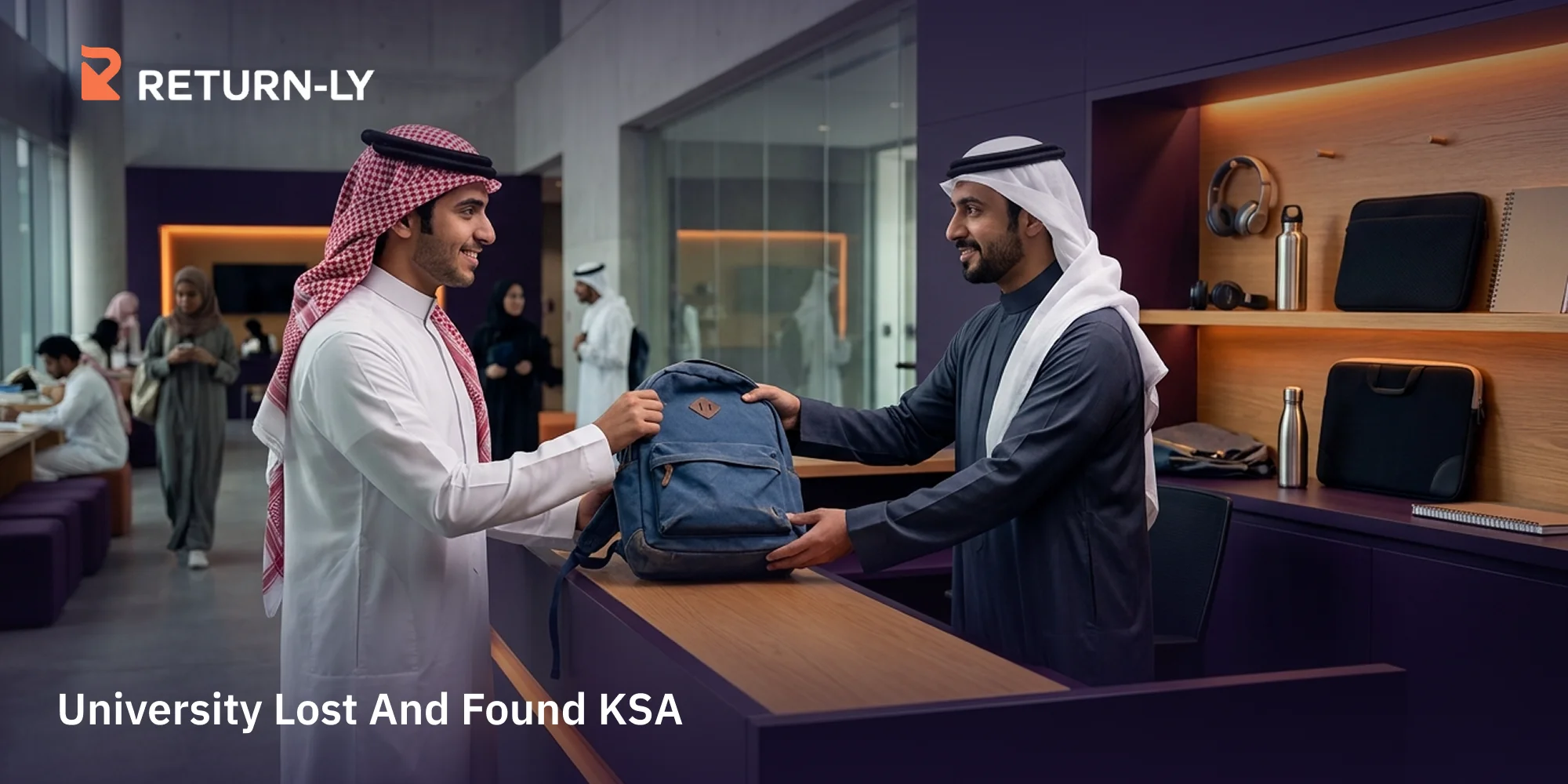
A missing laptop after a lecture, a phone left in the library, or a textbook forgotten in a study room may seem like a small operational issue. For students, however, losing an important personal item can disrupt classes, communication, and access to study materials.
The challenge becomes greater on large campuses where security teams, reception desks, libraries, student services, and academic departments may all receive lost property. A structured university lost and found KSA process helps bring these reports into one organized workflow, making it easier for authorized staff to record found items, review lost-item reports, verify ownership, and return belongings safely.
A university campus is not a single building with one reception desk.
Students move between:
An item found in one location may be handed to campus security, while its owner reports it to student services. If those teams use separate notebooks, spreadsheets, phone calls, or messaging groups, the two records may never be compared efficiently.
The problem is therefore not always that the item cannot be found. Sometimes the university has the item but does not have an efficient way to connect the available information.
Not every lost item should be handled in exactly the same way.
A notebook or water bottle may be relatively easy to identify. A phone, tablet, or laptop requires more careful handling because it may contain private files, university accounts, banking applications, messages, and other personal information.
Staff should avoid accessing the contents of a locked device simply to identify its owner.
Instead, useful identifying details may include the device type, brand, model, external color, protective case, visible damage, stickers, or the approximate location where it was lost.
Some details should also remain undisclosed so they can later be used to verify ownership.
Books are among the most common items that can move unnoticed between classrooms, libraries, study areas, and student accommodation.
But identifying a book is not always as simple as checking its title.
Several students may own the same textbook, particularly when it is required for a course. Useful distinguishing information can include:
A well-organized system records enough information to distinguish similar items without publicly exposing every identifying detail.
The biggest operational improvement often comes from reducing fragmented records.
Consider a simple scenario.
A student leaves headphones in a lecture hall. A faculty employee finds them and sends them to security. The student first asks the department receptionist, then contacts student services, and later calls campus security.
If every team stores information separately, three departments may spend time answering the same question.
A centralized university lost and found KSA process gives authorized employees a common reference for lost reports and items recorded as found.
That does not guarantee recovery, but it significantly improves the organization of the search process.
A useful report should collect enough information to identify the item without encouraging students to submit unnecessary sensitive data.
Depending on the item, relevant details may include:
Item category: Phone, laptop, book, wallet, keys, bag, headphones, or another category.
Description: Color, brand, model, size, distinctive markings, or other visible features.
Loss details: Approximate date, time, building, classroom, or campus area.
Contact information: Only the information reasonably required to communicate with the person submitting the report.
Optional image: Where supported and useful for identifying the item.
Students should not be asked to submit device passwords, banking credentials, verification codes, or other information that is unrelated to proving ownership.
A lost-property system becomes ineffective if students can submit reports but staff do not consistently record what they find.
The employee handling the found item should document it as soon as reasonably possible.
Useful information may include where it was discovered, when it was found, its general appearance, and where it was placed for secure storage.
This reduces dependence on employee memory.
It is particularly important in universities because shifts change, buildings close, and the employee who found an item may not be available when the owner contacts the university several hours or days later.
Returning an item quickly matters, but returning it to the correct person matters more.
For common items, a general statement such as “I lost a black phone” may not provide enough information to establish ownership.
Universities can ask the claimant to provide distinguishing details that were not publicly disclosed.
For example, the owner of a laptop might identify its model, case, sticker placement, or visible damage. A student claiming a textbook may be asked to describe personal notes or markings inside it.
The exact verification method should match the nature and sensitivity of the item.
Public posts such as “A black iPhone was found outside Building A” can sometimes help, but publishing too many identifying details creates another problem.
If the university shares the model, case design, wallpaper description, accessories, and exact location, it may leave very little information for the genuine owner to use during verification.
A better approach is to separate:
Public or general information, which can help potential owners recognize that an item may have been found.
Internal identifying information, which remains available to authorized staff for ownership verification.
This distinction is particularly important for valuable devices, wallets, keys, and other sensitive belongings.
Without a structured system, students naturally keep contacting the university.
They may call security in the morning, email student services in the afternoon, and visit the building where the item was lost the next day.
Each enquiry creates additional work because another employee has to reconstruct the situation.
A centralized digital process reduces this duplication by keeping the relevant report information in one place for authorized teams.
The practical benefit is straightforward: staff spend less time asking other departments whether an item was found and more time dealing with cases that genuinely require investigation or verification.
The problem becomes more complex when a university operates several campuses, colleges, or geographically separate facilities.
A student may remember losing an item “at university” without immediately knowing whether it was left in the main library, a college building, a student residence, or another campus.
Every record should therefore be associated with the most specific known location.
This allows teams to narrow the search without forcing the student to contact multiple buildings individually.
For universities with large physical footprints, location structure can be as important as the description of the item itself.
Digitizing reports does not remove the need for physical control of found belongings.
Items still need to be stored appropriately until the university completes the relevant process.
Higher-value or sensitive property may require more restricted handling than low-value everyday belongings.
Operational responsibilities should therefore answer practical questions such as:
Who receives a found item?
Where is it stored?
Who is authorized to access or release it?
What information should be checked before handover?
A digital record works best when it supports a clear physical handling procedure rather than operating separately from it.
In the general RETURN-LY workflow, when the service is activated at a partner location, the owner of a lost item can submit a report containing contact details, the item description, color, date of loss, category, and an optional image.
If an employee at the activated partner location finds an item, the employee records it separately.
After the item is identified, ريتيرنلي | RETURN-LY contacts the owner with information about where the item is located and the available collection or shipping options.
There is no direct communication between the person who lost the item and the employee who recorded the found property.
For a university, this type of workflow could provide a more organized channel when the service is activated at that location. It does not mean that RETURN-LY is currently available at every university in Saudi Arabia or that a partnership exists with a particular institution.
Not every student discovers the loss immediately.
A visitor may return to another city. A student may leave campus for the weekend. An international student may realize that an item is missing only after reaching their accommodation or another destination.
Once ownership has been properly verified, the institution can follow the collection procedure available for that case.
Where shipping is available through the service being used, it may also provide an option for returning an item when in-person collection is impractical.
This can be especially valuable on large university campuses where students and visitors do not necessarily live nearby.
Automation and centralized records are useful, but they should not turn lost-property management into an automatic release process.
Staff involvement remains important when:
Technology should reduce repetitive administrative work, not remove sensible checks.
Some problems continue even after a university introduces a digital form.
One common mistake is allowing different departments to keep separate unofficial records. Another is recording descriptions that are too vague to distinguish between similar belongings.
Delays in recording found items can also make later identification harder, particularly when information about the location or time of discovery is forgotten.
Universities should also avoid collecting excessive personal information simply because a digital form makes it possible.
A useful system is not the one that collects the most data. It is the one that collects the right information and makes it available to the right people.
An effective university lost and found KSA process connects three activities that are often treated separately: reporting a lost item, recording an item found by university staff, and verifying ownership before return.
When those activities are organized through one clear workflow, students are less dependent on repeated calls to different departments, while employees gain a more consistent way to handle belongings found across campus.
The goal is not to promise that every missing device, book, or personal item will be recovered. It is to make the process more structured, easier to manage, and clearer for both students and university staff.
Universities typically store found devices securely and verify ownership before returning them. Books can be identified using details such as the title, author, edition, personal notes, labels, or other distinguishing marks.
Students should provide a clear description, approximate loss location and date, distinguishing characteristics, and the contact information needed for the university to communicate with them.
No. Passwords, verification codes, banking information, and other sensitive credentials should not be required simply to report or identify a lost device.