
.png)
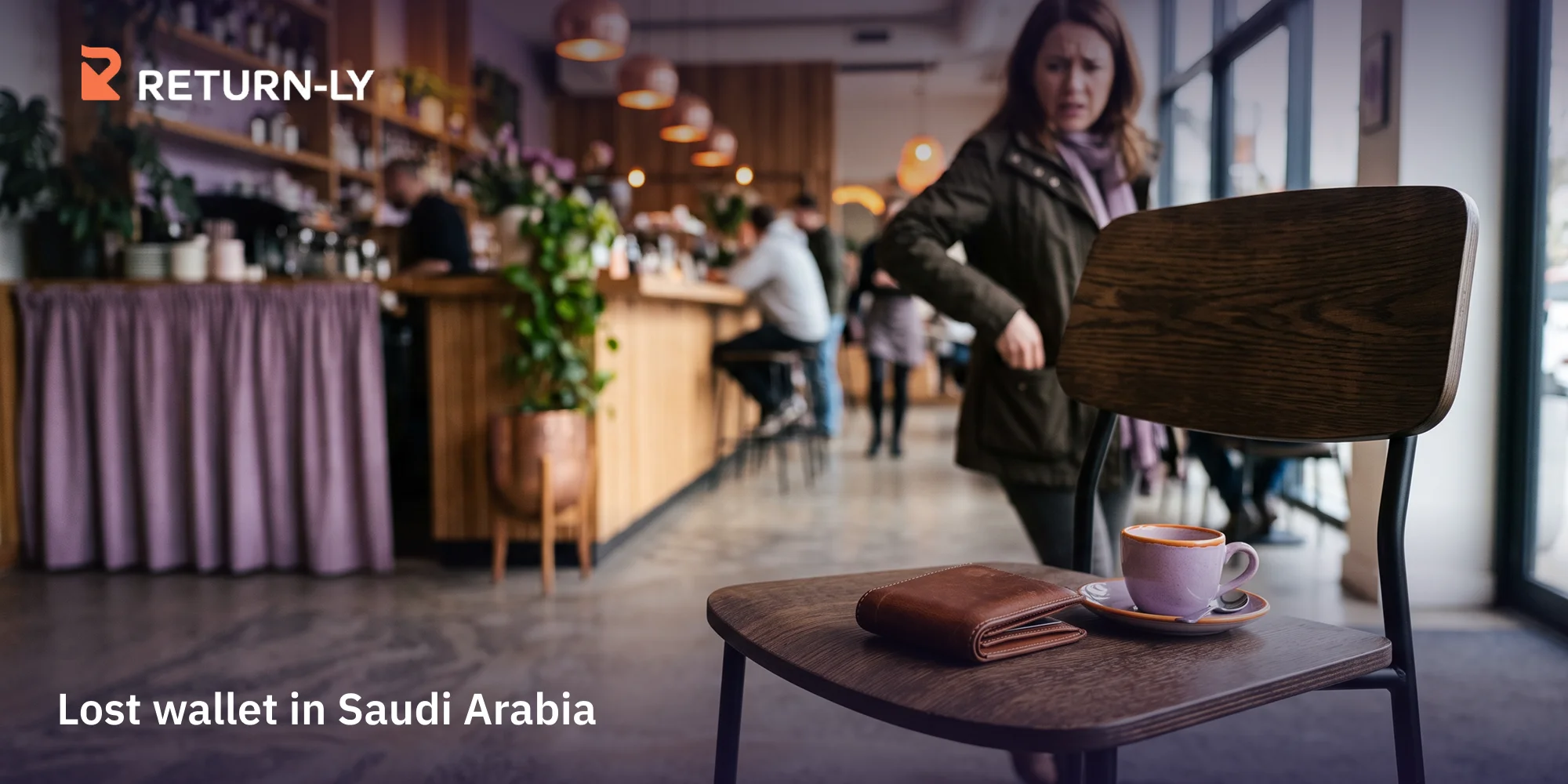
A lost wallet in Saudi Arabia can expose you to more than the loss of cash. It may contain bank cards, a Saudi national ID, an Iqama, a driving licence or other documents that could be misused if they reach the wrong person.
Act in two directions at the same time: protect the cards and documents inside the wallet, then organise the physical search at the place where it may have disappeared. Do not wait for the wallet to be found before blocking payment cards or reporting important documents.
Where ريتيرنلي | RETURN-LY is activated at a partner location, it may support the search and recovery process. However, it does not replace Absher, the police, banks or any government authority responsible for cancelling or replacing documents.
Start by checking the places where wallets are commonly overlooked: jacket pockets, shopping bags, the car, hotel room, restaurant table or payment counter. Review your movements in order instead of returning randomly to several locations.
Once you are reasonably sure the wallet is missing:
The first priority is preventing financial loss. Saudi Central Bank rules require card issuers to provide round-the-clock channels for reporting lost or stolen cards, and credit card issuers must suspend a card immediately after receiving the report.
A wallet itself is not reported through one universal Absher service. The correct route depends on what was inside it and whether the circumstances indicate ordinary loss or possible theft.
Use Absher to report eligible missing government documents, such as a Saudi national identity card. If the wallet was stolen, suspicious transactions appeared or the circumstances require security intervention, contact the nearest police station or use the official security-reporting channel available for citizens and residents.
This distinction is important:
Submitting one report does not automatically complete the other steps.
Saudi citizens can report a lost national ID and request a replacement electronically through Absher. The service also allows delivery of the replacement card to the registered national address.
The process generally includes:
Do not publish a photograph of the lost ID or its complete number while asking for help online. Share sensitive details only through official services or when ownership must be verified by a trusted authority.
To ensure your request is processed instantly, you can successfully register your report by Submit Claim via this direct link: https://claims.return-ly.com/new-claim
A resident who loses an Iqama should not treat the loss as a simple missing-wallet issue. Ministry of Interior guidance states that a lost residence permit must be reported to the passport authority within 24 hours, or to the nearest police station where no passport authority is available.
Notify your employer, sponsor or responsible family member according to your residency status, then follow the official replacement procedure. The search for the physical wallet can continue, but it should not delay the required report.
If the original Iqama is later found after replacement procedures have started, consult the responsible authority before using it again.
When dealing with a lost wallet in Saudi Arabia, do not postpone card cancellation because you believe the wallet may appear within a few hours.
Contact each bank through its official application, authenticated channel or emergency telephone number. Request that the cards be frozen or cancelled and ask for a report reference.
Under Saudi Central Bank rules, banks and card issuers must make 24/7 channels available for reporting lost or stolen cards. A credit card issuer must suspend the card immediately after receiving the report and send the customer a confirmation with a reference number.
Review recent transactions carefully. Report any payment you do not recognise through the bank’s official dispute process rather than contacting the merchant alone.
Do not share:
A person who claims to have found your wallet does not need these details to return it.
Cash is difficult to identify unless it remains inside the recovered wallet. When reporting the loss to a venue, describe the wallet itself before listing the amount of money inside it.
Useful identifying details include:
Avoid publishing every identifying detail publicly. Keep at least one distinctive feature private so you can verify that a person or lost-and-found employee has the correct wallet.
Membership cards, work access cards and transport passes should be reported to their issuing organisations. Ask whether they must be cancelled or can simply be replaced.
The correct search route depends on the place where the wallet was last used.
Contact customer service or security and give them the approximate time, shop names and payment locations. Bank notifications or digital receipts may help you reconstruct your route.
Ask for a report or reference number when available. Do not rely only on calling individual shops, because the wallet may have been transferred to the mall’s central lost-and-found office.
Determine whether the wallet was lost inside the aircraft or within the airport building.
Contact the airline if it may have been left in a seat pocket or overhead compartment. Contact airport lost and found if it disappeared near check-in, security, immigration, a lounge, restaurant or shop.
Provide the flight number, terminal, gate and approximate time. An airline and an airport lost-and-found office perform different roles, so contacting one does not always cover the other.
Check the safe, bedding, luggage and reception desk. Give the hotel your room number, stay dates and the last time you used the wallet.
The RETURN-LY hotel workflow differs from the general partner-location process. Where the system is activated, a hotel employee records the item, the system identifies the guest through room information and an automatic notification is sent. The guest does not submit a lost-item report, and the general matching workflow is not used.
Record the route, vehicle or trip number, boarding point, destination and travel time. Contact the transport operator quickly because vehicles may move between routes or service locations.
Do not attempt to enter restricted transport facilities or approach a driver outside official procedures. Give the operator a clear description and keep the report reference.
Where and when RETURN-LY is activated at a partner location, the owner can register contact details and a description of the lost wallet, including its colour, category, date of loss and an optional image.
If an employee finds the wallet at that partner location, the employee records it in the system. After the item is identified, RETURN-LY contacts the owner and explains the available collection or shipping options. There is no direct communication between the wallet owner and the employee who recorded it.
This workflow must be described conditionally. It does not mean RETURN-LY is currently available across every airport, mall, hotel or transport provider in Saudi Arabia. It also does not replace:
The platform’s role is limited to organising the search and recovery process at an activated partner location.
A visitor reaches the car park after shopping and discovers that the wallet is missing. The wallet contains two bank cards and a national ID.
The visitor immediately freezes both cards, checks recent transactions and contacts the mall’s customer service desk. The national ID is reported through Absher without waiting for the mall to complete its search.
If RETURN-LY were activated at that partner location, the visitor could register the wallet’s description and contact information. A mall employee would separately record the wallet if it were found, and RETURN-LY would contact the owner after identification.
This is an illustrative scenario, not a documented incident or a claim that RETURN-LY is active in a specific mall.
Do not automatically reactivate or use everything inside the recovered wallet.
A cancelled payment card may remain invalid even when found. Contact the bank before attempting to use it. If a replacement identity document has been requested or issued, follow the instructions of the authority responsible for that document.
Check whether any card or document appears to have been removed, copied or tampered with. Continue monitoring bank transactions and change relevant account passwords when there is a reasonable risk that sensitive information was exposed.
The most serious mistake is spending hours searching while leaving cards active. Protecting your accounts should happen before repeatedly contacting venues.
Other avoidable mistakes include:
When facing a lost wallet in Saudi Arabia, secure the financial items first, report each official document through its correct channel and continue the physical search at the responsible location.
Use Absher to report eligible official documents inside the wallet, such as a Saudi national ID. Contact the nearest police station when the wallet was stolen or the circumstances require a security report.
Yes. Report lost or stolen cards through your bank’s official 24/7 channel so they can be suspended and replaced.
No. RETURN-LY may support the search inside an activated partner location, but official document, banking and police procedures remain separate.